Bhutan
The Kingdom of Bhutan is a tranquil country where you can explore the ancient cultures, beautiful landscapes and magnificent architecture.
Bhutan, called Druk Yul by its people, is known as the “Land of the Thunder Dragon''. It is one of the world’s most beautiful, yet mysterious places. It is located on the eastern edge of the Himalayan Mountain region. A large part of the area is forested, welcoming a diverse ecosystem of flora and fauna. The country stretches from subtropical valleys and plains to snow capped mountain ranges. This landscape makes it the perfect place to trek through the majestic valleys or steep mountains to visit ancient architecture and Buddhist temples.
Bhutan has a rich culture where most of its 700,000 inhabitants practice the Buddhist religion. This secluded land has a rich history embedded into the society and shows through the festival reenactments. Bhutan’s ancient cultural traditions have continued to grow despite the current technological restructuring. Only since the mid 1970’s technology has come to Bhutan. It has become the ultimate tourist destination for adventurers, spiritual awakenings, and serene visages.
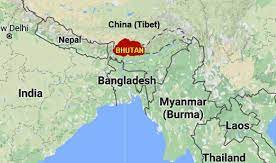
Where is Bhutan located?
The Kingdom of Bhutan is a small landlocked country located in the South Asia region. The South Asia region consists of Afghanistan, Pakistan, India, Nepal, Bhutan, Bangladesh, the Maldives and Sri Lanka. Bhutan is located in the southern foothills of the Himalayan mountain range, sandwiched between two superpowers - the People's Republic of China in the north and the Republic of India in the south. Tibet is located on its northern border, while three Indian cities are bordering Bhutan with Sikkim to the east, Arunachal Pradesh to the east and Assam state to the south.
Bhutan is a sovereign nation with a total land area of 38,394 km² and a population of around 771,608 people making it one of the least populated countries.
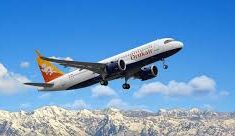
Drukair, The Royal Bhutan Airlines has flights that enter through the illustrious Paro Valley. The airline operates out of nine cities in six countries. No matter where you are in the world, Drukair will get you to the most peaceful place on Earth. Representatives can help you schedule the best way to fly to Bhutan. Expect expert service and care when you fly Drukair. Flights from Bangkok, Thailand and Kathmandu, Nepal havedaily arrivals. Other flights use Singapore, Dhaka, Bangladesh, Sydney, Australia, and Kolkata, Bagdogra, and Gaya, India.
Gross National Happiness
Why is Bhutan known for the word Happiness?
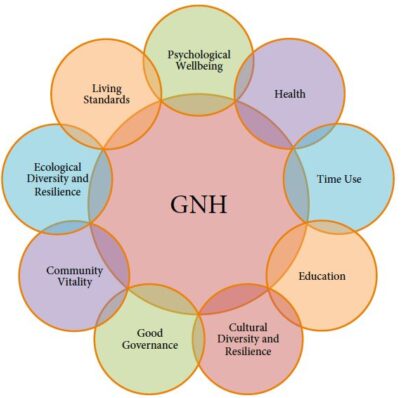
Bhutan is known famously as the first country in the world to measure progress based on happiness. To do so, the 4th Druk Gyalpo coined the term Gross National Happiness (GNH). From then on, GNH was used to measure the country’s development instead of Gross National Product (GNP). The happiness of the Bhutanese is more important than material growth and there should be a balance between the two. A GNH Commission was created to take an annual measure of how the people fare. The poll is based on an index of nine domains. Living standards, education, health, cultural diversity and resilience, community vitality, time use, psychological well being, ecological diversity, and good governess are the nine domains that are taken into account. According to the GNH Commission, 81.5% of the population of Bhutan is deeply happy. The Commission is still working on ways to achieve total happiness for 100% of Bhutanese.
Bhutan Facts
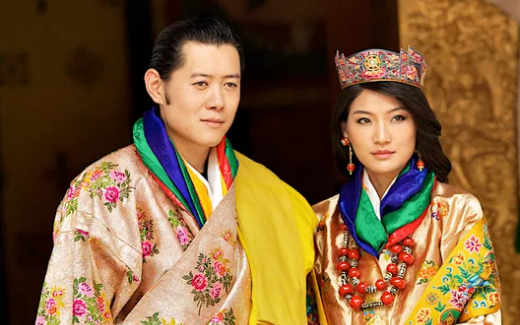
Bhutan's King and Queen
His Majesty, the King Jigme Khesar Namgyel Wangchuck was extremely popular even before he married a commoner, Jetsun Pema. His family line has welcomed the throne for the past 100 years. He is the fifth ruler in his family to take possession on the crown. Bhutanese admire and love the royal family.
National Flower
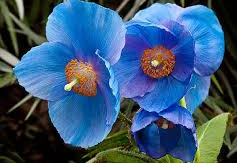
The national flower of Bhutan is the Himalayan Blue Poppy or Euitgel Metog Hoem. This unique flower grows above tree level on rocky mountain regions.
State Religion
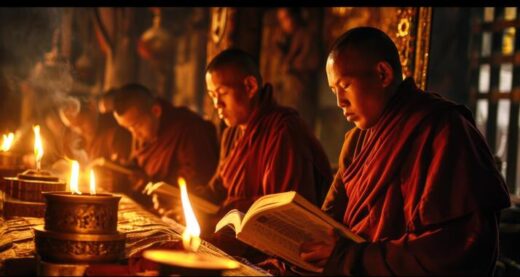
The official religion is Vajrayana Buddhism. Bhutan is the last kingdom to practice Vajrayana Buddhism. The teachings allow one to embody both mind and body. You will reach enlightenment if you follow and understand the concepts of emptiness, wisdom, compassion, and skillful means.
National Animal
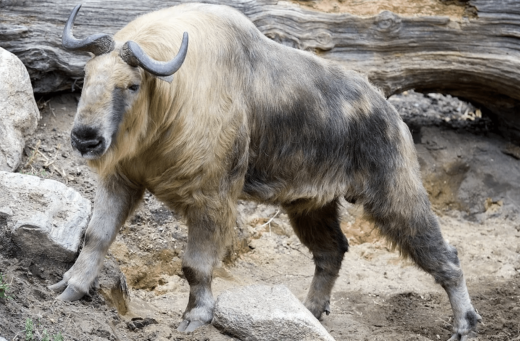
The Takin, or gnu goat is Bhutan's national animal. It lives in forested areas in mountain areas of 4,000-meter altitudes and above. Takin’s have a stocky body on short legs with two-toed hoofed feet. It has a long nose and stout horns. These animals feed on bamboo, grass, leaves, and other plants. Takin are rare, therefore they are anendangered species.
National Sport
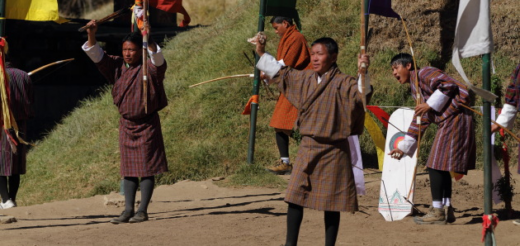
Archery became Bhutan's national sport in 1971. Although only men were allowed to play during festivals, tournaments, and religious celebrations, Tshering Choden was the first female archer to be asked to enter into the Summer Olympic Games.
National Carrier
Bhutan's national carrier is Drukair. Established in 1981, The Royal Bhutan Airlines, Drukair began as a small, single-strip airline company. As interest to Bhutan grew, so did the airline. There are 3 airports in Bhutan, which include Paro, Bumthang, and Gelephug. The airline now operates out of 6 countries and 12 cities. Drukair connects flight to and from Dhaka, Bangladesh, Kathmandu, Nepal, Bangkok, Thailand, and Singapore. Drukair also travels to Bagdogra, Delhi, Gaya, Kolkata, and Guwahati, India. Drukair has a professional team that provides quality, reliability, and safe travel for both domestic and international flights.
Language
The official language in Bhutan is Dzongkha. Bhutanese also speak Tshanglakha and the Lhotshamkha. Tshanglakha is spoken in the western region of the country and Lhotshamkha is used by the southern Bhutanese. There are at least 19 dialects of Dzongkha that are spoken all over Bhutan. Most of the people that are in the tourism industry speak English. English is the medium of instruction in Bhutanese schools.
Currency
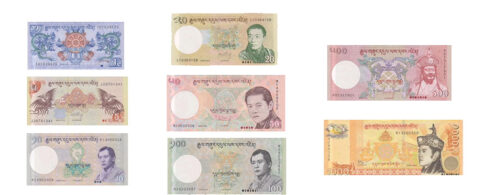
Ngultrum (NU) is Bhutan's currency. Until the 1960's, Bhutanese bartered goods and services because therewas no paper money. Today, in addition to ngultrum, you can use Indian rupeesat different shops and restaurants around the country.
Culture and Costume
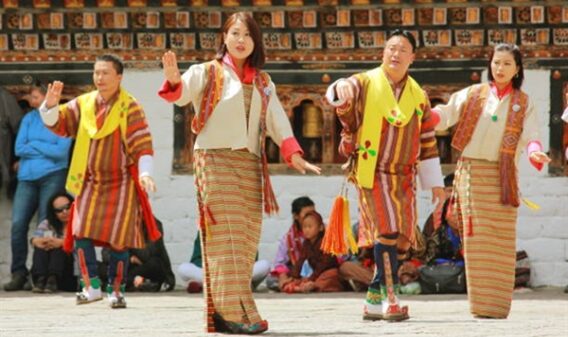
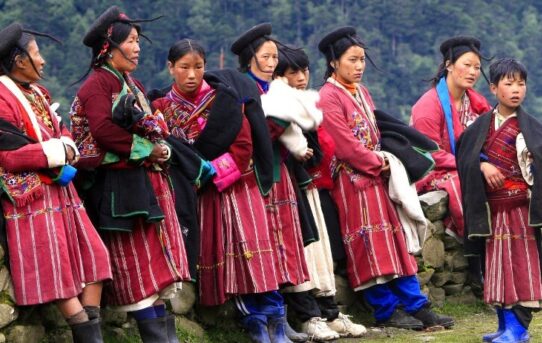
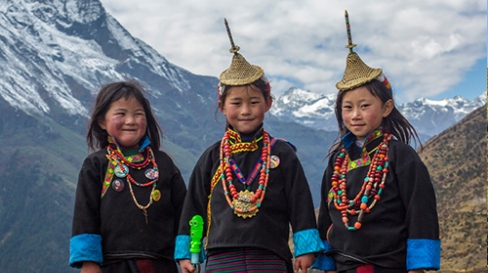
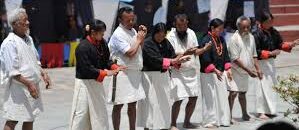
The official language in Bhutan is Dzongkha. Bhutanese also speak Tshanglakha and the Lhotshamkha. Tshanglakha is spoken in the western region of the country and Lhotshamkha is used by the southern Bhutanese. There are at least 19 dialects of Dzongkha that are spoken all over Bhutan. Most of the people that are in the tourism industry speak English. English is the medium of instruction in Bhutanese schools.
Buddhist Painting
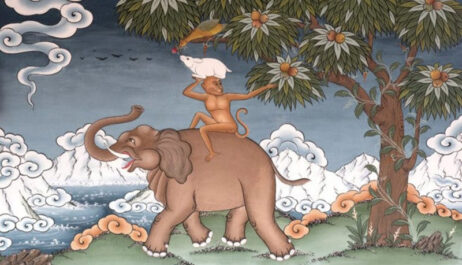
Buddhist paintings are found in dzongs, goembas, and lhakhangs. The hand-painted murals tell stories that deliver messages of peace and harmony. One example is the Thuenpa Puen Shi (Four Friends) mural depicts the harmonious efforts between a monkey, peacock, elephant, and a rabbit. The four decided to work together to grow fruit that they all wanted to eat. Each had a job and through cooperation and harmony, they were able to reach the fruit after it had grown into a tree.
Prayer Wheel
Buddhist paintings are found in dzongs, goembas, and lhakhangs. The hand-painted murals tell stories that deliver messages of peace and harmony. One example is the Thuenpa Puen Shi (Four Friends) mural depicts the harmonious efforts between a monkey, peacock, elephant, and a rabbit. The four decided to work together to grow fruit that they all wanted to eat. Each had a job and through cooperation and harmony, they were able to reach the fruit after it had grown into a tree.
Wildlife & Sanctuaries
There is a diverse amount of flora and fauna in the Kingdom of Bhutan. Because of the varying temperatures, creatures enjoy the subtropical and arctic climates.
Although there are some rare animals in the National Park, trekking through the mountainous regions will give a glimpse of a variety of wildlife animals, like the blue sheep. The blue sheep is a cross between a goat and a sheep. It has a bluish hue during the winter months and can be viewed between 1800-4300 meters. Yaks, wolves, musk deer, fat marmots, and takins also love the high atmospheric temperatures.
Bhutan is home to 3 species of langurs and 600 species of birds. Langurs are monkeys with both gray or golden-brown fur and interesting black faces. The birds migrate to the wondrous and peaceful Bhutan country atdifferent times of the year. The raven is the national bird. It represents one of the Bhutan deities, Gonpo Jarodongchen. The protected black-necked crane another bird that is revered by the people.
Over 50% of the country protects its wildlife. Whether in national parks or wildlife preserves, the conservation efforts exist to maintain the animals’ life and culture.
Bhutan Architecture
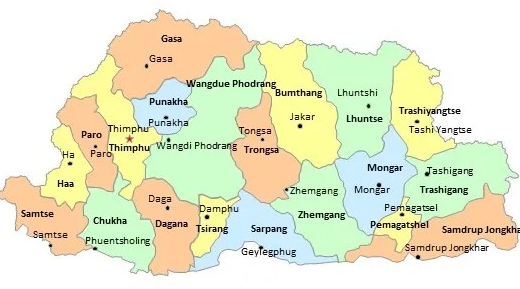
Bhutan is filled with stunning architectural building, such as dzongs, goembas, and lhakhangs. Dzongs primary function, beginning in the 17th century, was as a fortress. Today the buildings are used as administrative offices for each of the 20 dzongkhas (districts) in Bhutan. Dzongs are made of stone or pounded mud and timber with wooden shingled roofs. Even though fires caused many of the dzongs to be rebuilt, reconstruction method are consistently traditional with the exception of iron roofs instead of wooden.
Goembas are monasteries. Each goemba contains an autonomous community complete with a temples and a dormitory. Goembas have a khemar just beneath the roof, in fact all religious buildings in Bhutan have this large red stripe. Brass plates are placed on the khemar to represent the sun. Goembas often have painted murals that depict the Wheel of Life, the Six Symbols of Longevity, and the Guardians of the Four Directions. A geometric poem on a small quilt is dedicated to Zhabdrung is often at the entrance of goembas.
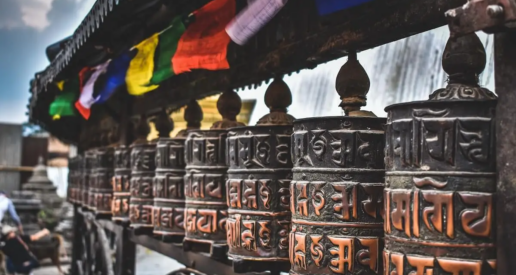
Lhakhang have yellow roofs with a bell-shaped ornament painted in gold on the top. Similar to goembas the entrances of Lhakhang have painted murals depicting with the Guardians of the Four Directions or the Wheel of Life. People walk outside of the building in a clockwise direction and spin the prayer wheels located on the lower level outside of the lhakhang. After spinning the prayer wheels torelease positive prayers, you will enter the temple into a great hall. The walls will be covered with astonishing Buddhist paintings with an altar that sits at the end of the hall. A statue of an ancient Buddhist figure, Guru Rinpoche or Jampa, dominates the area.
History of Bhutan
Founded in early 2000 B.C., Bhutan was known by many names. Some of the names included Lho Jong, Lho Mon Kha Shi, Lho Jong Men Jong, and more. During the 17th century, it became officially known as Druk Yul, the "Land of the Drukpas". Drukpas referred to the religion of Buddhism that the people began to practice, which is now the dominant religion of the country. Previously in the 7th century, Bonism was the religion in Bhutan until the Tibetan King Songtsen Gampo and Guru Rinpoche introduced and taught the people the details of Buddhism.
Ngawang Namyel, the first Zhabdrung, established his power after he arrived in 1616 A.D. He defeated several Tibetan armies and unified battling Bhutan tribes. He started a governing system that was followed until his death. The system broke down and infighting began. A new system of government began with the establishment of a monarchy. The first Druk Gyalpo, or Dragon King provided rules for Bhutan citizen to have a better way of life. In 1971, Bhutan officially became a participating member of the United Nations.
The Bhutan Way of Life
The isolate Himalayan country has preserved its culture and traditions for thousands of years. Bhutan still tries to preserve its culture even through the new modernization efforts and technological influences. Bhutanese practice Buddhism, the religion that was brought to them in the 7th century. While the majority of the country is Buddhist, the southern region practices Hinduism. The Bhutan people keep their religious traditions alive with festivals and other events that celebrate their history.
More than 60% of Bhutanese are farmers, breeding livestock and harvesting crops. These rural people are self-sustaining. They make their own clothing, food, decorations, and bedding. Only small amounts of people live and work in urban areas. Most work in the service industries where they can be tour guides, teachers, army members, or police officials. Women are able to work in these industries, in addition to producing weaving for additional household income.
When you vacation in Bhutan, you will come to realize that the Bhutanese are kind, open, and generous. They will leave you with a memorable friendly impression and a
wonderful cultural experience after visiting the kingdom.